
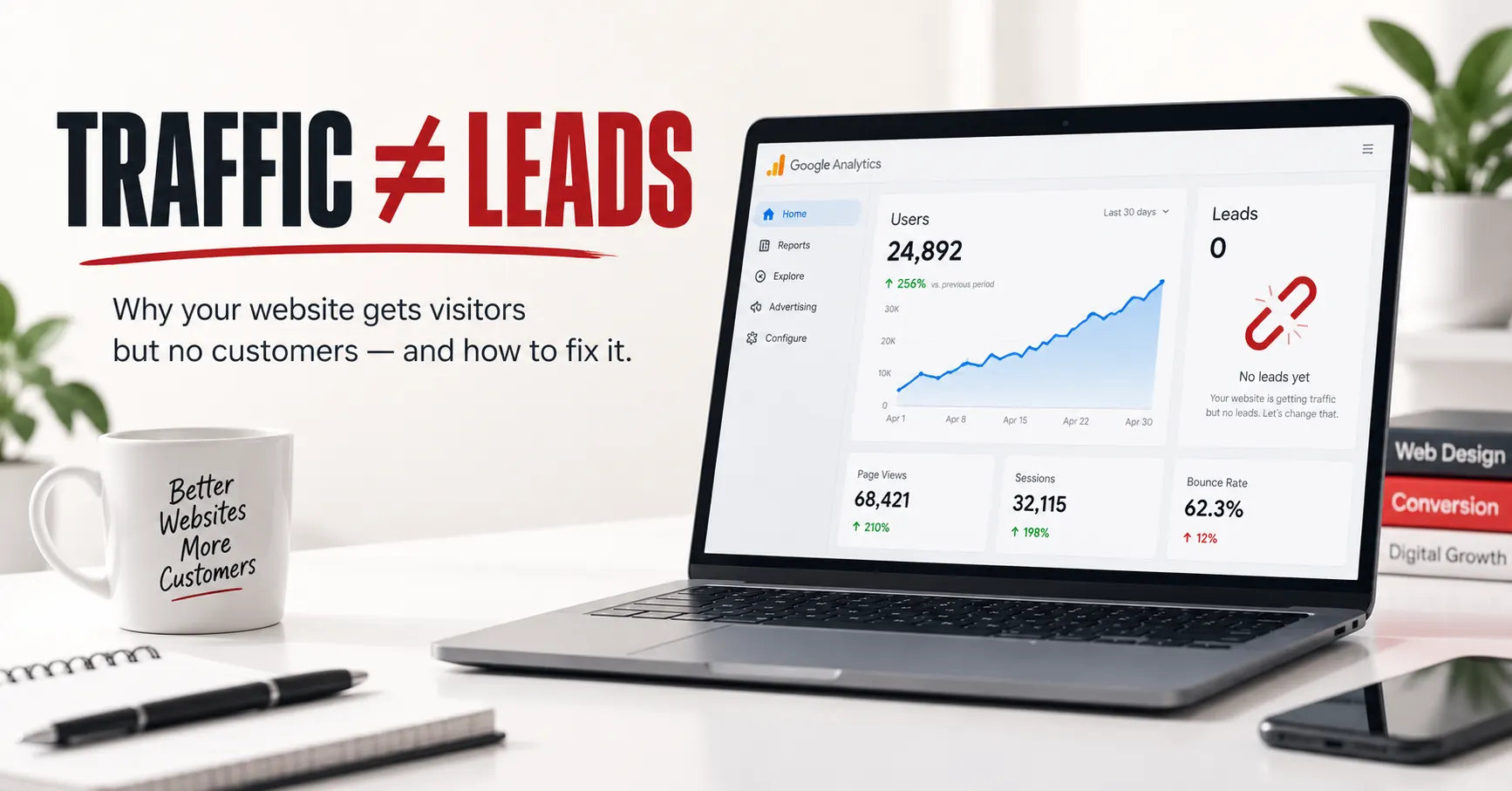
You check Google Analytics and the numbers look fine. People are showing up. Sessions are climbing. Your ads are driving clicks, your blog is pulling in organic visitors, maybe you even got a nice bump from a social media post that did well.
Then you check your inbox. Nothing. No form submissions, no calls, no new enquiries. Just traffic that comes and goes without ever telling you who they are.
This is one of the most frustrating situations a business owner can be in, because it feels like the problem should be obvious, but it usually isn’t. Traffic and leads are two completely different things, and a website can be good at generating one while being terrible at generating the other.
Below are the nine most common reasons this happens, based on patterns I see over and over again when auditing business websites. Some of these will take you five minutes to fix. Others might mean rethinking a page entirely. Either way, by the end of this you’ll know exactly where to look.
1. Your Website Doesn’t Say What You Actually Do
Visitors decide whether to stay on a page within a few seconds. If your homepage headline is vague, clever, or written more for you than for them, people leave before they even understand what you’re offering.
A headline like “Building Tomorrow’s Solutions Today” tells a visitor nothing. A headline like “We Help Small Manufacturers Cut Delivery Times by 30%” tells them everything they need to know in one line.
Fix: Your homepage should answer three questions in the first screen a visitor sees: what do you offer, who is it for, and what result do they get. If someone has to scroll to figure that out, you’re losing them.
2. There’s No Clear Next Step
A lot of websites are built like brochures. They describe the business, list some services, show a nice gallery, and then just… end. There’s no obvious action for the visitor to take.
People don’t convert on their own. They need to be told what to do next, and that instruction needs to be visible without hunting for it.
Fix: Every page on your site should have one primary call-to-action that’s impossible to miss. “Get a Quote,” “Book a Call,” “Start Your Order,” whatever fits your business. Repeat it near the top, in the middle, and at the bottom of longer pages.
3. Your Forms Ask for Too Much, Too Soon
A contact form with twelve fields feels like a job application. Most visitors, especially ones who are just starting to consider working with you, will close the tab rather than fill it out.
Fix: Strip your main enquiry form down to the essentials: name, email, and one field about what they need. You can always ask for more details once they’ve replied. Getting the first message is the goal, not qualifying them in the first form.
4. You’re Attracting the Wrong Traffic
Not all traffic is created equal. If you’re ranking for broad, informational keywords, or running ads with loose targeting, you might be pulling in a lot of people who were never going to buy from you in the first place.
This is a quiet killer because the traffic graphs look great in reports, but the leads never show up, and it’s easy to blame the website when the real issue is who’s arriving at it.
Fix: Look at your top traffic sources and keywords. Are they specific to your service, or are they broad terms that anyone could be searching for? Tighten your targeting and your content around what your actual buyers search for, not what gets the most volume.
5. Your Site Is Slow, and People Are Leaving Before It Loads
This one doesn’t even make it into most site owners’ thinking, because they never experience it themselves. But if your site takes four or five seconds to load on a phone with average signal, a large chunk of visitors never see your content at all.
Fix: Run your site through Google’s PageSpeed Insights. Compress oversized images, remove unused plugins, and if you’re on a heavy page builder theme, consider a leaner build. Every second of load time costs conversions, this is well documented and not an exaggeration.
6. There’s Nothing on the Page That Builds Trust
Would you hand your money or your business problem to a company with no reviews, no case studies, no proof of past work, and no sense of who’s actually behind it?
Most visitors won’t either. If your site reads like it could belong to anyone, it doesn’t give people a reason to choose you over the next search result.
Fix: Add real testimonials with names and details, not vague quotes. Show actual results or examples of past work. Include a photo and a short bio of who they’ll be working with. Trust signals aren’t decoration, they’re often the deciding factor.
7. Your Design Looks Outdated or Inconsistent
Fair or not, people judge credibility by appearance. A website with mismatched fonts, stretched images, or a layout that feels stuck in an older era of the internet quietly tells visitors that the business behind it might be just as outdated.
Fix: You don’t need a flashy redesign, but consistency matters. Clean spacing, a coherent color palette, readable fonts, and mobile-friendly layouts go a long way toward making your business look current and trustworthy.
8. You’re Not Optimized for Mobile Behavior
More than half of most websites’ traffic now comes from phones, yet plenty of business sites are still designed and tested only on desktop. Buttons that are too small to tap, text that requires zooming, forms that break on smaller screens, all of it quietly pushes mobile visitors away.
Fix: Actually open your site on your own phone and try to complete the action you want visitors to take. If it’s frustrating for you, it’s frustrating for them too.
9. You’re Not Following Up With the Leads You Do Get
Sometimes the website isn’t the problem at all. Leads come in, but they sit in an inbox for three days before anyone responds, or they get a generic auto-reply and nothing after that.
Fix: Speed matters enormously here. Studies on lead response time consistently show that responding within the first hour dramatically increases the chance of converting a lead compared to waiting even a few hours longer. Set up instant notifications for new enquiries and make fast responses a habit, not an afterthought.
How to Actually Diagnose Your Website’s Problem
If you’ve read through the list above and you’re not sure which of these apply to you, here’s a simple way to check:
- Look at your analytics: where are visitors leaving from, and how long are they staying?
- Watch a screen recording of someone unfamiliar using your site (tools like Hotjar or Microsoft Clarity make this easy and often free).
- Test your own forms and calls-to-action on both desktop and mobile.
- Ask a friend who knows nothing about your business to visit your homepage and tell you what you do, within ten seconds.
Most of the time, it’s not one single issue. It’s two or three of these problems compounding on each other, a slow load time combined with a vague headline, or a strong headline undone by a form that’s too long. Fixing all of it usually means looking at the site as a whole rather than patching one thing at a time.
Frequently Asked Questions
Why does my website get traffic but no sales?
Usually it comes down to unclear messaging, missing or weak calls-to-action, slow load times, or a lack of trust signals like testimonials and proof of work. Traffic just means people are arriving, it doesn’t mean the site is convincing them to take action.
How do I know if my website has a conversion problem?
Check your analytics for high bounce rates, short session durations, and low form completion rates. A screen recording tool showing real visitor behavior is one of the fastest ways to spot exactly where people are getting stuck or leaving.
What’s a good conversion rate for a business website?
It varies by industry, but most service-based business websites should aim for somewhere between 2% and 5% of visitors converting into leads. If you’re significantly below that, it’s usually a sign that one or more of the issues above needs attention.
Should I redesign my whole website or just fix specific pages?
Start with your highest-traffic pages first, usually the homepage and your main service pages. A full redesign isn’t always necessary; often targeted fixes to messaging, forms, and calls-to-action can produce noticeable improvement without touching the entire site.
Turning Traffic Into Actual Business
Getting people to your website is only half the job. The other half, the part that actually pays the bills, is turning that traffic into enquiries, calls, and customers. That’s a matter of strategy and structure as much as it is design.
If you’ve gone through this list and recognized a few of these problems on your own site, that’s a good sign. It means the fix is identifiable, not a mystery. And if you’d rather have someone look at it with fresh eyes and handle the fixes for you, that’s exactly the kind of work I do.
Get a free quote and let’s turn your website into something that actually works for your business, not just something that looks good.
